Showing posts with label Mapping Information Space. Show all posts

Tuesday, April 7, 2009

Web Trend Map 4 Release


Every visual thinking blogger in the blogosphere is going to be blogging about it, but it's just so damn cool that I have to do it too. Information Architects have just released their Web Trend Map 4. Popular domains on the Web are mapped to the Tokyo Metro and organized by how they are most related to the cities. Heights represent success in traffic and branding. Subway lines are colored by area of interest. Check it out!

Wednesday, February 20, 2008

Surveying the Information Space Mapping Terrain

Following Monday's blog post, I spent some time reviewing the websites that I linked to and exploring a little more. I was a bit disappointed with what I found exploring the Cybercartography thread. It seems to be very closely tied to real world geography, which is all well and good, but not what I'm looking for.

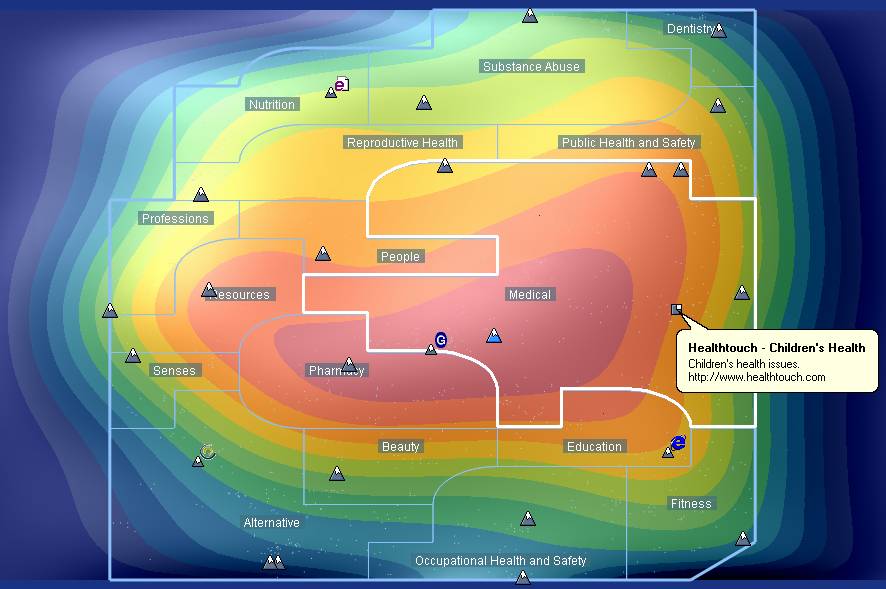
The Atlas of Cyberspace has some examples that seem to more closely match the kind of thing that's intriguing me. Particular examples include the "ET-Map" - a multi-level category map of the information space of over 100,000 entertainment related Web pages listed by Yahoo!, Kartoo, and WebMap.

What these have in common is that they map, or maybe chart is a better term, non-geographic things, relationships of data and information. (I'm beginning to think that map is probably the wrong term to use with this concept, since the term map is so closely tied to representations of geographic space like the earth, moon or sky).

If you're having trouble understanding what the hell I'm rambling on about and trying to discover, well, so am I. But, my wife sent me a link to an article that's maybe the best example so far of the type of visual depiction of information that's intriguing me and that I'm trying to find examples of.

On the Boxes and Arrows website there's an article titled, "A Map-based Approach to Content Inventory," by Patrick Walsh. Patrick needed to visually depict the content of his Intranet. Understanding the content and relationships between content was getting unwieldy. A perfect opportunity for a visual thinking graphic. What Patrick came up with was a map-based representation of his Intranet. The map is based on subway style maps showing nodes and connections. Aha! It's mapping and it's mapping an information space. There's really no geography associated with it. It's just information. So, if you're at all interested in this thing I'm calling mapping information space, check out this article. If you've seen any examples similar to this, it would be great to get some feedback. Just post a comment to this blog.

Monday, February 18, 2008

Mapping Information Space

At the recent VizThink conference, I attended a couple of breakout sessions on mapping; Bruce Daniel's "VizMaps: An Alternate Approach to Describing Where" and John Grimwade's "Mapping the Possibilities."

At the time, I wasn't really sure what attracted me to these two mapping sessions, but reflecting upon it now, I think I was hoping that one or both might delve into the realms of non-real world mapping. I was having a tough time putting my finger on what that meant, what my expectations from these sessions had been, and what more I wanted out of them and it occurred to me that what I was after was something I'll call Mapping Information Space.

I've been working in computers as either a computer systems analyst, programmer or web developer since 1994 and over those years I've dealt with the design of computer systems and had to "map" data and information flow, processes, interactions between user and system, etc. Most of these have had at least some visual explanation component to them.

In all those years I was making diagrams of information flow, human-computer interactions, and what-not, I never really considered it to be mapping. But now that this vague concept has been forming in my brain since VizThink, I think that's exactly the right term. So, in an effort to try to discover the information space mapping terrain, I want to do some research on the subject and document it here in this blog. And, who knows, maybe I'll be able to find out enough and find enough experts and interest to recommend it as a topic of VizThink '09.

To start things out, I Googled the words mapping information space. This resulted in 21,900,000 results. One of the first on the results page is this site called, An Atlas of Cyberspace. I've only skimmed it a bit so far, but looks like interesting stuff.

Another of the results I found is a book titled, "Cybercartography Theory and Practice." It appears to define cybercartography as "a new paradigm for maps and mapping in the information era. Defined as 'the organization, presentation, analysis and communication of spatially referenced information on a wide variety of topics of interest to society...' " Hmm. Looks like cybercartography might the the 'official' term for what I'm looking for. There's even a Wikipedia entry for it.

Ok. Enough for now. Time to go exploring and see what else I can find.